
No Stat Is Free: What MLB's New Normal Reveals About 2026 Draft Strategy


Back in June, I wrote about developing a year-round mind for fantasy baseball.
Every decision, from your first-round pick to a late-season waiver add, should flow from one connected view of the game.
That starts with reading the macro environment. It’s been both elusive and essential ever since the Juiced Ball Era began, when league-wide home run-to-fly ball rates started swinging wildly from one year to the next.
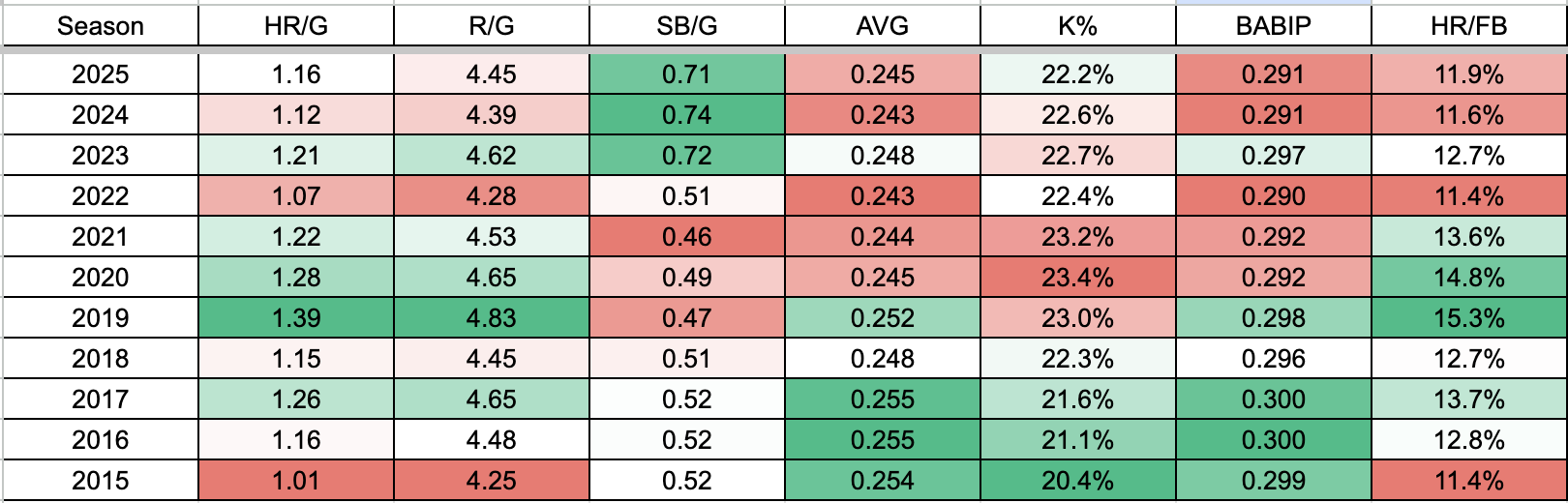
Then came the shortened 2020 season, followed by a chaotic stretch in 2021 and 2022. Sticky stuff bans, a lockout, and whiplash stat lines defined the era.
In hindsight, this was the league’s true transition period. Power dried up almost overnight, a stark contrast from the fireworks of 2019. Stolen bases nearly vanished, just before erupting in ways we hadn’t seen in decades. The fantasy landscape was challenging to anchor, caught between what had been and what was coming.
Then came 2023, when sweeping rule changes reshaped what we thought was possible, especially on the bases. Now, three seasons into the new Major League Baseball, the chaos has quieted.
And that gives us something we haven’t had in years: a clear edge heading into draft season.
Stolen Bases: Spike, Then Stall
It’s remarkable how quickly we’ve reached a new baseline for steals per game. You might’ve expected stolen base rates to ricochet like home runs did during the juiced ball era.
Instead, SB/G jumped 41% from 2022 to 2023 — the biggest single-season increase in MLB history.
(For the baseball historians: the biggest drop came from 1948 to 1949, a nearly 24% decline as the league shifted toward power in the postwar era.)
Fluctuations have stayed within 4% in each of the past two seasons, something that’s happened just 47 times in 123 years.
This suggests that while year-to-year steadiness isn’t unprecedented, it’s not the norm either. And back-to-back seasons of such low volatility? Even rarer.
Heading into 2026, fantasy managers should embrace a stable stolen base environment.
The End of Easy Power
The home run boom defined the second half of the 2010s. From 2015 to 2019, HR/G rose 38%, peaking at a record 1.39 per game, the height of the juiced ball era.
The shortened 2020 season saw a sharp decline, and by 2022, HR/G had fallen to 1.07.
Since then, power production has rebounded, but not to previous highs. HR/G has stabilized in the low 1.10s for two straight years, echoing pre-peak levels like 2016 and 2018.
This isn’t a dead-ball era, but it’s a clear step down from what came before. For fantasy, that means 30-HR bats are more scarce again, and power is concentrated in fewer players.
Just look at the number of 30-homer hitters over the past 10 full seasons. The 2019 spike is apparent. So is the compression since.
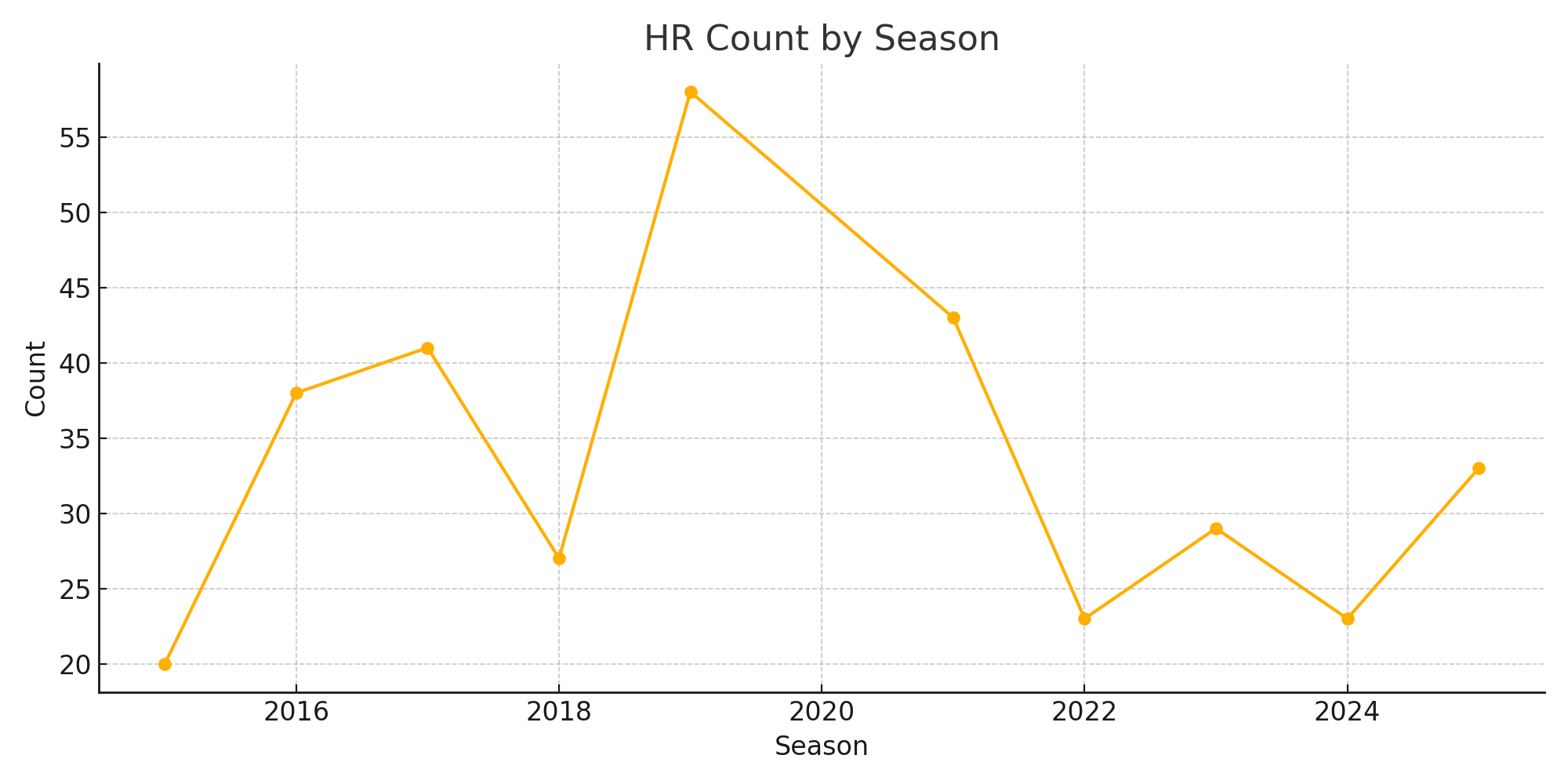
Why? Because league-wide HR/FB rate is down roughly 22% from its 2019 peak. The game still rewards raw power, but marginal fly balls that used to scrape over the wall now die at the track.
That’s crushed the “middle class” of sluggers.
In 2019, 129 players hit at least 20 homers. Over the past two seasons, the average is just 92.
Meanwhile, top-end production hasn’t flinched. Pete Alonso led the league with 53 homers in 2019. Four players matched or exceeded that mark in 2025.
The takeaway? Power still exists, but it lives almost exclusively at the top. There are fewer paths to cobbling it together late in drafts or on waivers. If you want real home run production, you need to prioritize it early and often.
The Rise of True Dual Threats
Only six seasons in MLB history have featured four or more 30/30 players.
Two of them have come since the 2023 rule changes.
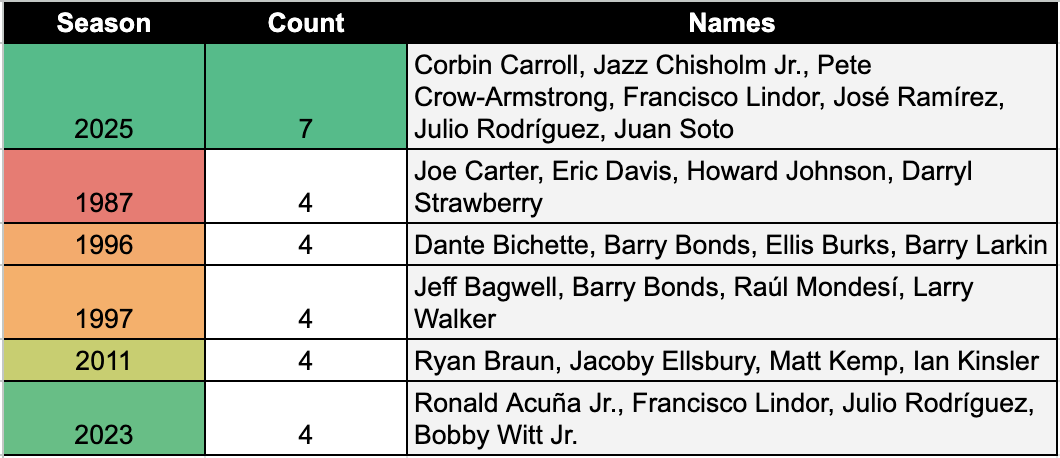
And in 2025, the league shattered that record, with seven players going 30/30.
Lower the bar to 25/25, and 2025 leads there too, with 11 players reaching both marks.
The fantasy impact is massive.
Among the top 20 finishers in FanGraphs’ auction calculator for 12-team roto leagues, only three returned a negative value in stolen bases.
Power-speed stars have always been valuable, but what’s changed is how concentrated that production has become. We’re seeing more 30/30 seasons, yet fewer players who contribute meaningfully across multiple categories.
That widening gap is making it harder to win with one-dimensional profiles. As mentioned in the previous section, true power is at a premium right now. But if you aren’t stealing bases or hitting for average, you’d better have 35+ homer upside.
Batting Average Remains Scarce
Five of the 10 lowest league-wide batting averages on record have come since 2020.
Even 2023, the so-called rebound year, topped out at .248. Excluding those five recent seasons, you’d have to go back to 1972 to find an average that low.
In other words, while home runs and steals have rebounded to near-historic levels, batting average remains stuck near the floor.
That’s no accident. Strikeouts, once a red flag, have become standard. League-wide K% hasn’t dipped below 22% in eight seasons. Meanwhile, BABIP has drifted from around .300 in the mid-2010s to just .291 today, meaning fewer cheap hits and less margin for error.
What’s emerged is a harsher contact environment. With fewer balls in play and fewer hits falling in, AVG has become more volatile, and one-dimensional contact hitters rarely move the needle.
Once again, the edge goes to multi-category contributors who can anchor average without sacrificing power or speed. When only a handful of hitters offer batting average and something else, that becomes a premium skill set worth drafting early.
What Wins Now: Balance
Ultimately, fantasy value comes down to scarcity and efficiency. How many boxes can a player check without dragging you down somewhere else?
This has always been true to a degree, but recent seasons have bent the statistical environment in ways that forced adjustments.
In 2019, we chased power to keep up.
In 2023, we chased speed.
In 2026? You want balance.
There’s no longer a single category swinging wildly year over year. Home runs and stolen bases remain elevated compared to historical norms, but after two seasons of relative steadiness, we’ve likely reached a new league equilibrium.
With no stat inflating at runaway speed, players who consistently contribute in multiple areas are the ones who separate.
A hitter who slashes .268 with 24 HR, 16 SB, and 90 runs? That’s exactly the profile we’re targeting now.
In 2025, stars like Francisco Lindor and Julio Rodríguez delivered across the board. But league-winning value also came from names like Brice Turang, Josh Naylor, and Geraldo Perdomo — not because they dominated one stat, but because they chipped away at many.
Not everyone can help in all five categories. But further down the draft board, you want hitters who can at least contribute in two of the big three: AVG, HR, and SB.
Maikel Garcia and Nico Hoerner delivered average and steals.
Jazz Chisholm brought power and speed.
Jo Adell and Michael Busch offered just one, but with enough power to make it count.
What’s fading in value? One-dimensional skill sets.
In a league where no category is inflated, specializing in just one area doesn’t move the needle like it used to. Everyone’s closer to average, which means you need players who can separate across the board.
In this recalibrated landscape — where volatility has settled and no stat is “free” — category balance has become the most valuable currency.